5 questions every school should ask its student data
Five plain-language questions that help schools investigate student support, enrollment, resource, and program patterns with appropriate context.
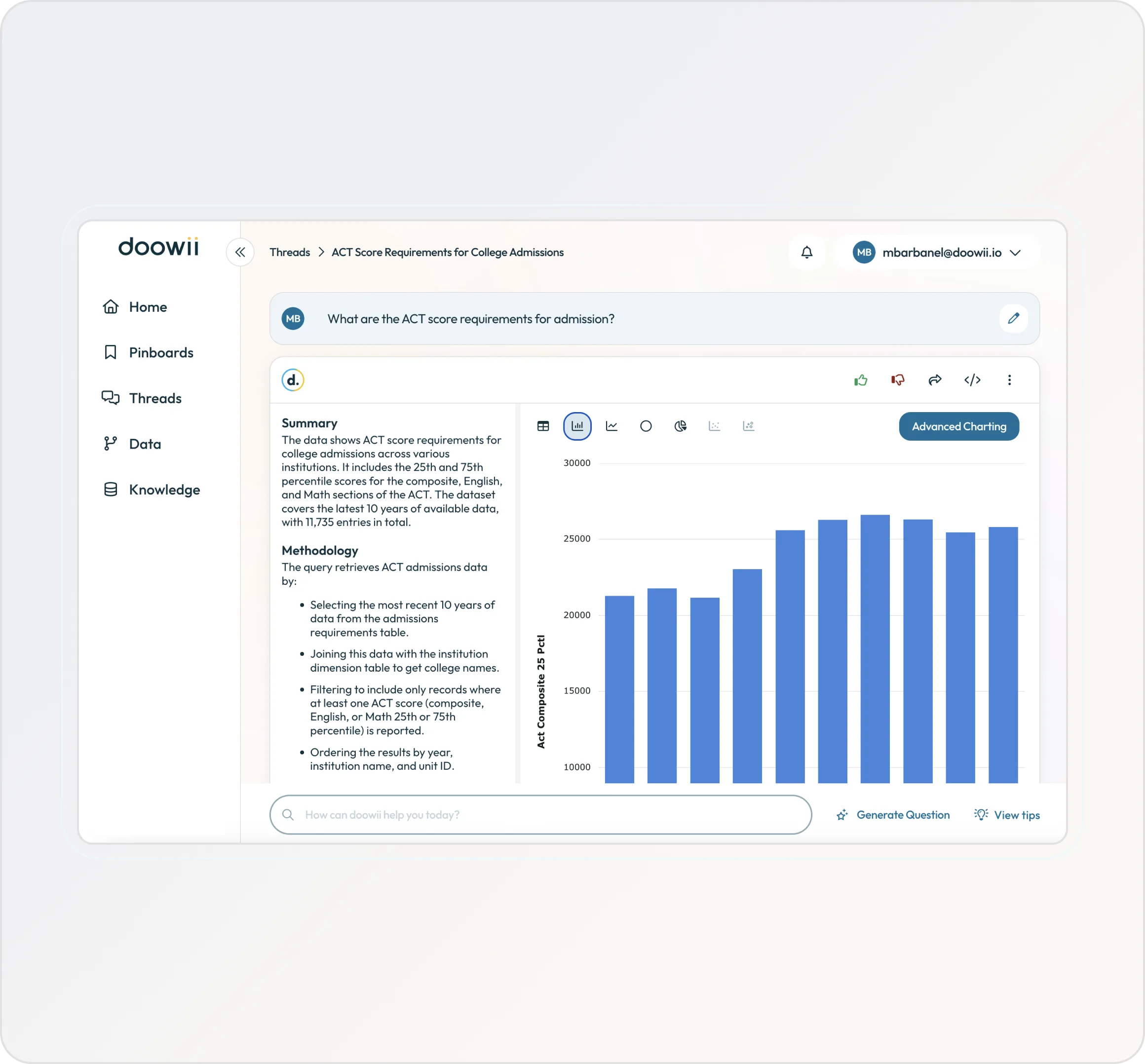
The best analytics program isn’t about dashboards; it’s about asking better questions. Here are five that a school or district should be able to investigate while the answer can still inform its work.
1. Which students or groups may warrant closer review?
Review institution-approved changes in attendance, course progress, engagement, advising, and other relevant context. The result should be a prompt for authorized staff to investigate, not a ranking that determines who a student is or what should happen next. A governed student retention analytics workflow keeps local definitions, contributing context, and human judgment connected.
2. How does our enrollment compare to our peer group?
For higher education, peer benchmarking against IPEDS data turns “our numbers” into “our numbers in context.” Ask which measures changed, how the peer group was selected, and whether the institutional and external definitions are comparable. A repeatable institutional reporting workflow should preserve that methodology.
3. What outcomes are associated with our programs and services?
Look at participation and outcomes by program, course, service, and relevant student group, not just usage totals. Descriptive differences can reveal questions worth investigating, but they do not establish that a program caused an outcome. Program owners should review the context, data quality, comparison approach, and other plausible explanations before changing resources or services.
4. Where are our resources over- or under-allocated?
Which schools or departments are stretched thin, and which have capacity? The answer usually lives across your SIS, ERP, and HR data, rarely in one place.
5. What patterns may be emerging?
Forward-looking analysis can estimate how retention, enrollment, or completion may change if recent patterns continue. Treat projections as uncertain planning inputs, review the assumptions and contributing factors, and revisit them as new data arrives.
The common thread
Every one of these questions requires data from multiple systems, unified and governed, with an answer available while it can still inform the work. That’s the premise of education-specific AI analytics: ask in plain language, review the methodology, and move from a question toward action.
See how Doowii supports questions and workflows like these in a guided demo.
See the unified platform in practice
Explore representative education workflows for governed questions, reports, and shared metrics.