One connected view across systems
Bring data from the SIS, LMS, ERP, CRM, assessment tools, and local sources into one unified platform.
Doowii brings institutional data, governance, analytics, reporting, and AI together, then runs the platform end to end as your AI data team.
Analytics, reporting & AI
One governed experience for every approved team
Education semantic & governance layer
Configured definitions, permissions, and context
Managed data layer
Connected, modeled, monitored, and maintained by Doowii
Institutional systems & existing stack
The sources, lake, warehouse, and tools you already run
Connect systems, definitions, and workflows once, then give every approved team a consistent way to understand and act on institutional data.
Bring data from the SIS, LMS, ERP, CRM, assessment tools, and local sources into one unified platform.
Give leadership, institutional research, enrollment, and student success teams access to the same governed definitions and context.
Support questions, dashboards, recurring reporting, monitored indicators, and predictive analysis without creating separate data silos.
Doowii handles the work behind answers, recurring reports, monitored indicators, predictive models, and AI workflows.
Doowii brings the technical foundation, education context, and team-facing workflows into one unified platform managed end to end. Institutional teams retain ownership of definitions and access decisions.
Bring approved data from the SIS, LMS, ERP, CRM, assessment tools, and local sources into one unified platform.
Map education concepts to local definitions, document calculation logic, and apply the permissions your institution requires.
Use the same governed platform for questions, dashboards, recurring reports, monitored indicators, and predictive analysis.
Keep the warehouse, lake, or reporting tools that serve you. Doowii connects education modeling, governance, analytics, reporting, and AI across the systems and investments in scope.
Where a shared data layer is not established, Doowii manages ingestion, modeling, governance, and platform operations end to end for institutional teams.
Questions, shared dashboards, recurring reporting, monitored indicators, and AI stay connected to the definitions, permissions, and review practices your institution governs.
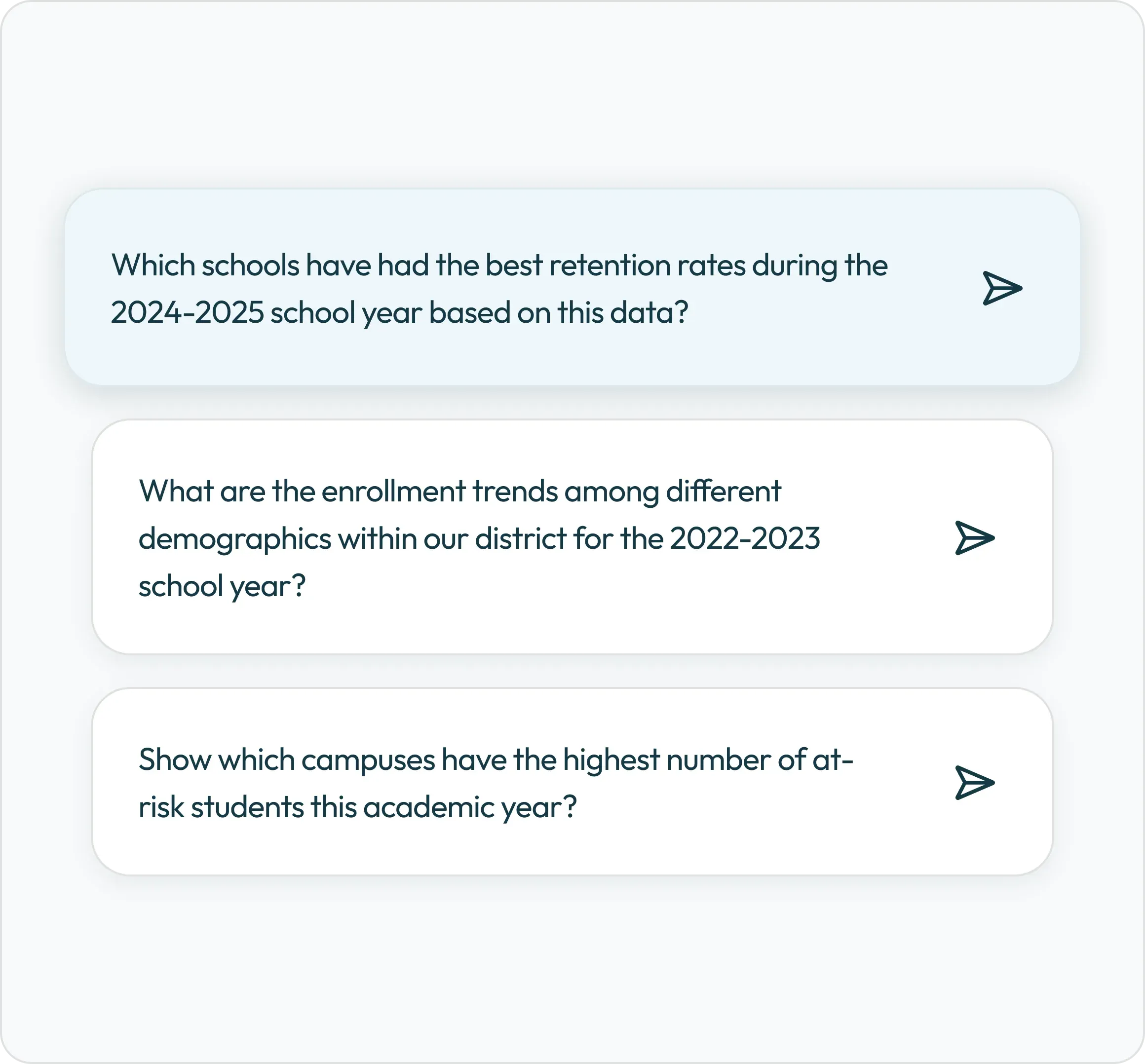
Doowii generates and runs a query against approved data, then returns a result with methodology and source context available for review. Definitions and access follow the standards set by institutional data leaders while approved users explore questions from the same platform.
Describe a recurring report once. Doowii helps assemble it, refresh it on schedule, and surface what changed for review. Board, cabinet, and term reporting remain connected to the same definitions used across the institution. See how that model supportshigher education institutional reporting.
Custom reports
Illustrative workflow
Chronic Absenteeism Report
Attendance · student groups · interventions
Enrollment Risk Analysis
Admissions · deposits · engagement
Board Outcomes Brief
Shared definitions · term-over-term change
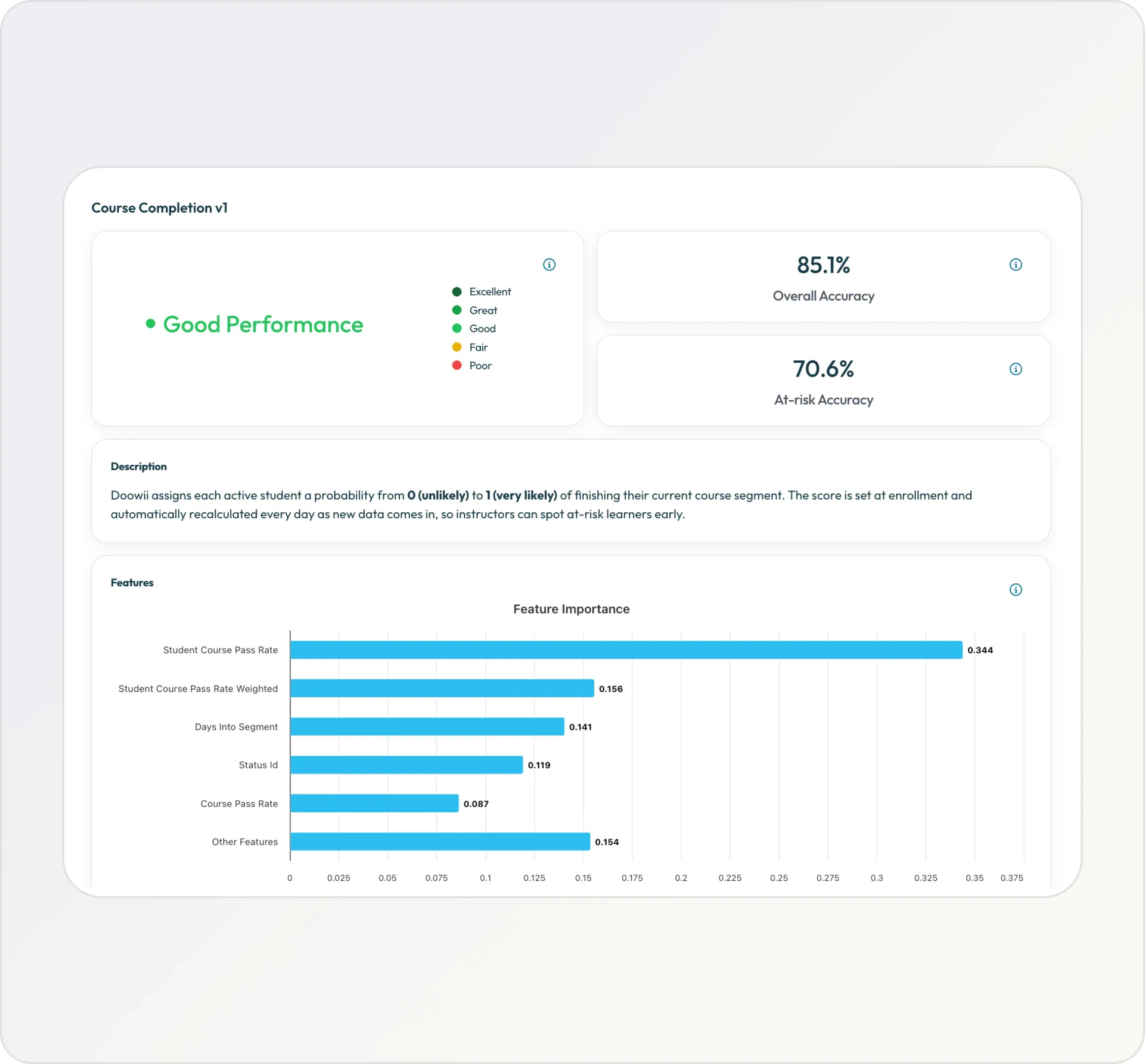
Models trained on approved institutional data can highlight students, cohorts, or enrollment patterns that may warrant attention. Contributing factors provide context, and your team remains responsible for decisions. Explore how this fits intohigher education AI analytics, or see the governed workflow behindstudent retention analytics.
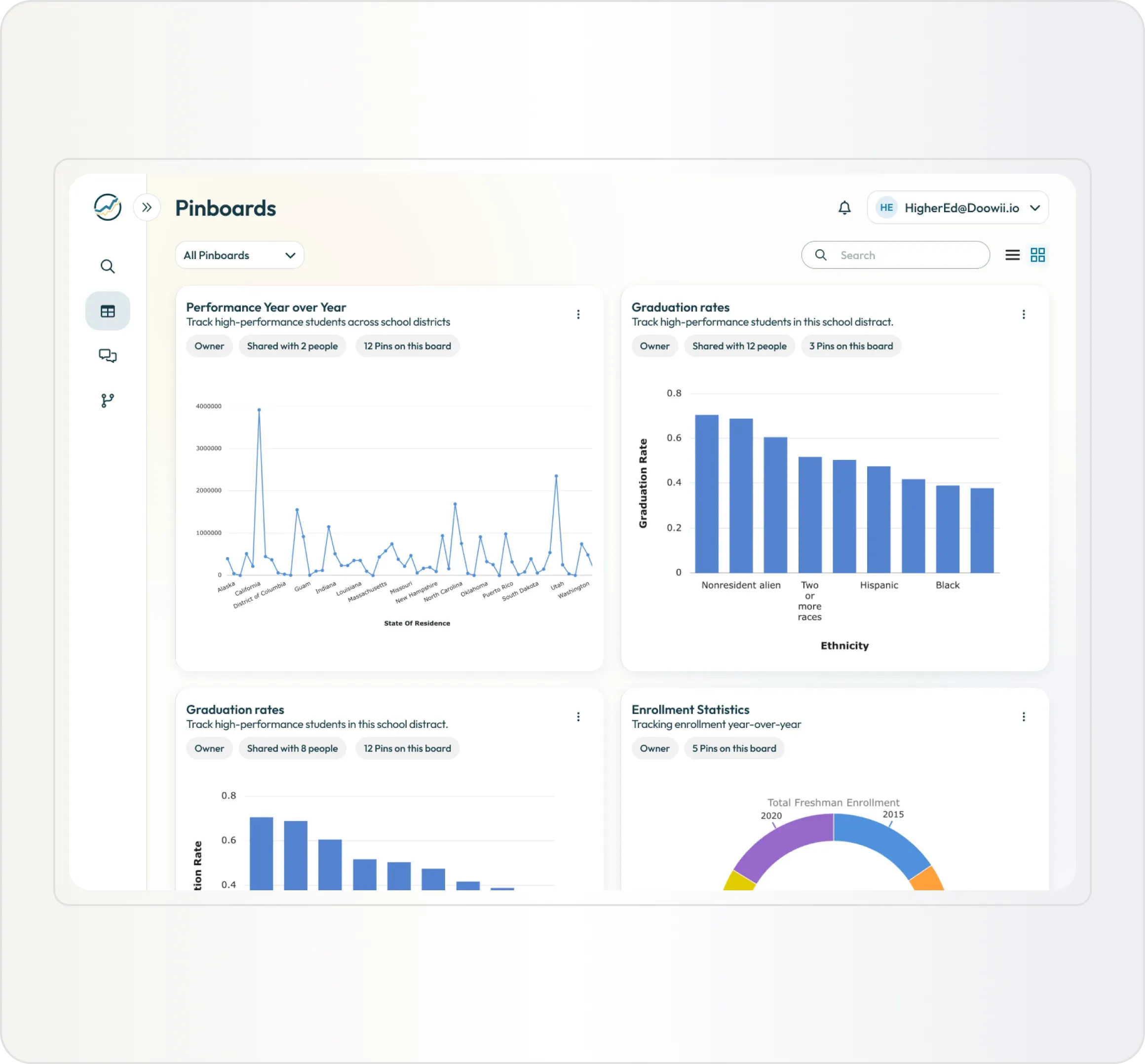
Bring the metrics each team watches into a shared board. Pinboards refresh on the configured data schedule, helping leaders and practitioners work from the same governed definitions as reports, questions, and models elsewhere in the platform.
Doowii starts with common education entities and relationships, then maps them to the definitions, hierarchies, policies, and permissions your institution uses. The model is a shared foundation for reporting, analytics, and AI, not a fixed catalog that overrides local practice. Explore how Doowii putshigher education data governanceinto active reporting, analytics, and AI workflows.
Students, staff, advisors, and the approved identifiers and relationships needed to connect records across systems.
Terms, calendars, courses, sections, programs, colleges, departments, and the hierarchies that organize them.
Applications, admissions, registrations, statuses, credits, completion context, and institution-defined academic progress.
Approved LMS activity, advising, outreach, financial context, and other support signals included in the workflow.
Common student, enrollment, course, attendance, and program concepts reduce the amount of context an institution has to create from scratch.
Cohorts, terms, statuses, and metrics are configured around local policy and operating practice rather than imposed as a generic template.
Permissions, documented logic, and source context help teams understand what a metric means and how it was assembled.
Exact entities, relationships, history, and refresh cadence depend on source availability, institutional definitions, and the agreed implementation scope.
Student persistence
Example review record
Illustrative only. Available evidence depends on deployment configuration, retained source and transformation lineage, source history, and retention policy.
Institutions can assemble infrastructure, extend a vendor ecosystem, or use a unified education data platform managed end to end. This comparison describes those common operating patterns rather than the capabilities of any individual vendor.
| Consideration | General-purpose platforms | Vendor-native analytics | Doowii |
|---|---|---|---|
| Primary design center | Flexible infrastructure intended for many industries and technical patterns. | Analytics designed around a specific product ecosystem and its data model. | One unified data platform designed around education systems, governance, and workflows. |
| Relationship to the existing stack | Often becomes part of the core data stack, with the institution selecting and assembling the surrounding services. | Fits most directly within the vendor’s suite; cross-stack work depends on its extension options. | Provides one unified platform across existing systems and investments, including a warehouse where one is already established. |
| Cross-system data | Broadly flexible, with connectors, models, and education context typically designed by the institution or its partners. | Often streamlined for data inside the ecosystem; external sources may require additional configuration. | Connection plans are shaped around the institution’s SIS, LMS, ERP, CRM, assessment, and local data. |
| Semantic layer | The institution defines education concepts, metrics, and governance patterns. | Begins with the vendor’s model, with configuration options varying by product. | Begins with education context, then maps definitions and metrics to institutional practice. |
| Operating responsibility | The institution and its implementation partners generally operate and maintain the assembled stack. | The vendor manages its product; the institution coordinates data and governance beyond that environment. | Doowii manages the platform end to end in partnership with institutional data and technology stakeholders. |
| Path to governed institutional use | Timing depends on architecture choices, staffing, integrations, and modeling scope. | Can be efficient inside the native ecosystem; broader use cases may add integration and governance work. | A phased implementation establishes the shared foundation around selected priorities, then expands across teams and workflows. |
| Data location and open access | The institution chooses storage and compute, with portability determined by the architecture it assembles. | Data location and access patterns follow the vendor's ecosystem; direct table access and export options vary by product. | Can use customer-owned storage, dedicated DuckDB compute in the customer's VPC and region, and open Iceberg access from compatible engines. |
Actual scope and operating model vary by product, contract, architecture, and institutional requirements.
Doowii scopes each connection around approved access, source capabilities, agreed mappings, quality checks, refresh cadence, and ownership. Depending on the system, product version, available APIs, and project needs, a connection may use a prebuilt pattern or institution-specific configuration within the unified platform.
A connected source is only useful when its delivery, meaning, relationships, and outputs remain reviewable. Doowii and institutional owners establish the checks that matter for each approved workflow, then maintain them as systems and policies change.
Monitor agreed ingestion and refresh workflows against the cadence and source capabilities defined for the implementation.
Review and maintain field mappings as source schemas, exports, institutional codes, and implementation requirements change.
Validate the people, terms, courses, programs, organizations, and relationships required for each approved workflow.
Compare modeled data and resulting metrics with source owners and functional experts before teams rely on them.
Exact checks, thresholds, refresh schedules, issue handling, and ownership are documented for the implementation.
Begin with the institutional priorities that matter most. Doowii then expands the unified platform across systems, teams, and workflows as data access, governance, and technical requirements are validated.
Align on the decisions, workflows, source systems, owners, and governance requirements that define the initial scope.
Establish approved data access, ingest the selected sources, and map institutional data to the education model.
Configure local definitions and permissions, then review outputs with the people responsible for the source data and metrics.
Roll out approved workflows, monitor the foundation, and update models and definitions as institutional needs change.
Doowii handles the ongoing technical and analytical work. Institutional leaders set definitions, policies, access, review standards, and the decisions the work supports.
| Responsibility | Doowii manages | Institution owns |
|---|---|---|
| Source connections | Configure and operate the agreed ingestion, mapping, refresh, and monitoring workflows within scope. | Authorize source access, confirm licensing and credentials, identify source owners, and approve the intended use. |
| Education data model | Map approved source data into the education model and maintain the agreed transformations and model configuration. | Own local definitions, hierarchies, policies, exceptions, and approval of the modeled meaning. |
| Data quality and validation | Configure agreed checks, monitor managed workflows, surface issues, and maintain the platform components within scope. | Set acceptable quality expectations, validate outputs with source owners, and resolve upstream data or policy issues. |
| Deployment and platform operations | Operate Doowii services and the deployment components assigned to Doowii in the documented architecture. | Approve account, region, network, identity, access, and retention decisions for customer-controlled environments. |
| Governance and use | Apply configured access controls and retain the available definition, methodology, source, and lineage context for review. | Own governance authority, legal interpretation, access decisions, validation, acceptable use, and consequential decisions. |
The exact division of responsibility is documented in the agreed implementation and deployment design.
Doowii normally runs the platform for you. When institutional security or architecture requirements call for a private deployment, we can operate the same managed platform with institution-owned storage, dedicated regional compute, and approved open-table access.
Exact cloud services, regions, network paths, engine compatibility, retention, and operating responsibilities are confirmed during architecture review.
Enterprise deployment option
Store Doowii-normalized education tables in object storage owned by your institution. Cloud account, region, identity, retention, and operating responsibilities are defined with your team.
Enterprise deployment option
Run dedicated DuckDB query compute inside your VPC and selected cloud region. Network paths, service access, and support boundaries are documented in the deployment design.
Available when included in the deployment
Give authorized institutional tools access to the same open Apache Iceberg tables Doowii maintains. Supported paths can include BigQuery, Spark, Databricks, and DuckDB, depending on each environment's Iceberg support and your catalog, identity, storage, and network configuration.
Configured through lineage and retention policy
Each committed Iceberg snapshot is immutable. Retained snapshot and transformation lineage let reviewers trace an analysis to the table version and source processing state used, subject to your retention policy.
Doowii maintains a SOC 2 Type II report and builds access control, encryption, and auditability into the platform’s operating practices. These controls support governed use across systems, teams, analytics, reporting, and AI. Detailed security and privacy information is available in the Security & Trust center.
Role-aware access
Permissions aligned to approved use
Encryption
Protections for data in transit and at rest
Auditability
Controls and activity designed for review
No. Doowii unifies the SIS, LMS, ERP, CRM, assessment, and other systems already in your environment. It can work with an existing warehouse or provide the managed data foundation when one is not established.
Doowii is the unified data platform for education, managed end to end. It connects and models institutional data, applies shared definitions and permissions, and supports analytics, dashboards, reporting, monitored indicators, and AI across approved teams.
It means approved data from institutional systems, shared definitions, access controls, analytics, reporting, and AI workflows operate on the same governed platform. It does not require replacing your SIS, LMS, ERP, CRM, assessment systems, or an existing warehouse.
Doowii begins with common education entities and relationships, then maps them to your institution's sources, terminology, hierarchies, definitions, permissions, and workflows. The model is configurable and can include custom data that matters only to your organization.
Data and institutional research leaders set definitions, access, governance, and review standards. Doowii handles the day-to-day platform operations and repeatable analytical work, giving the team more capacity while approved campus users get a governed way to use institutional data.
Results can include the interpretation, methodology, and source context used to produce them. Doowii is designed to support reviewable analysis rather than replace institutional judgment or automate consequential decisions.
We begin with the institutional outcomes and workflows that matter most, then connect the relevant sources, configure definitions and permissions, validate outputs with your team, and expand the platform across teams. Scope and timing depend on the systems and priorities involved.
Doowii operates the platform responsibilities documented for the implementation, which can include ingestion, mapping, modeled data, quality workflows, platform services, and ongoing maintenance. Institutional teams retain authority over source access, definitions, quality expectations, governance, permissions, validation, policy, and consequential decisions. Customer-controlled deployments also document account, network, identity, retention, and support boundaries.
Doowii maintains a SOC 2 Type II report and is designed to support institutions' student-data privacy obligations. Access, governance, and review are built into the platform, with additional documentation available through the Security & Trust center.
A private deployment can place dedicated DuckDB query compute in the customer's VPC and selected region, with normalized Apache Iceberg tables in customer-owned storage. The supported topology, cloud services, network boundaries, access model, and operating responsibilities are confirmed during architecture review.
Yes, when the deployment is configured for open lake access. Authorized institutional tools can access Doowii-normalized Apache Iceberg tables directly. Supported paths can include BigQuery, Spark, Databricks, and DuckDB, depending on each environment's Iceberg support plus the institution's catalog, identity, storage, and network configuration.
Each committed Apache Iceberg snapshot is immutable. Retained snapshot and transformation lineage can connect an analysis to the table version and source processing state used. Snapshot retention, access, and audit procedures follow the institution's agreed architecture and policies.
Start with the systems and institutional priorities that matter most, then expand the unified platform across teams and workflows.