District reporting without the recurring rebuild
Bring one board, attendance, or student-support report. See how Doowii connects your district systems, keeps definitions consistent, and maintains the reporting on one managed data and AI platform.
What we’ll cover in your demo
- Across schools. Bring SIS, attendance, assessment, and local data into one view.
- Ready to review. See the report, district definitions, and supporting sources together.
- Kept current. See how Doowii runs the data connections and recurring reporting.
No data upload needed to start the conversation.
Start with one report
See how your reporting could work
Tell us where you work. We’ll arrange a focused demo around your reporting priorities and follow up within one business day.
Prefer to choose a time now? Book with our team.
Go deeper on the workflow your team owns
Begin with one district-defined attendance, student-support, or analytics priority. Reuse the same governed identities, definitions, permissions, and source context as additional workflows come into scope.
Chronic absenteeism analytics
Connect attendance, enrollment windows, instructional calendars, district definitions, and approved support records for consistent, reviewable attendance workflows.
Explore attendance analyticsStudent supportMTSS and early warning analytics
Connect district-defined indicators, intervention records, progress measures, permissions, and team follow-through without turning a flag into an automated decision.
Explore MTSS analyticsAI and analyticsK-12 AI and data analytics
See how district data, governance, reporting, monitored indicators, predictive analysis, and human review operate on one managed platform.
Explore K-12 analyticsEvaluation guideK-12 data platform alternatives
Compare managed data foundations, analytics suites, and AI layers by the district systems and ongoing work each one supports.
Compare platform alternativesOne unified data platform for district-wide work
Doowii unifies district systems and manages the platform end to end, with shared definitions, permissions, and education context across attendance, intervention, reporting, and other workflows. Data leaders retain oversight of how metrics are defined and who can access them.
The same education-specific context powers analytics for both K-12 districts and higher education institutions, and Doowii maintains a SOC 2 Type II report. Its controls and privacy practices are designed to support districts' obligations under FERPA, COPPA, CCPA, GDPR, and other applicable laws.

A unified education data platform instead of disconnected tools
Doowii is built for education across district teams, not as another isolated dashboard or generic AI tool. Education-ready data models and definitions provide a practical starting point that districts can configure around their work.
| Consideration | General-purpose data stack | Vendor-native analytics | Doowii |
|---|---|---|---|
| Starting point | Flexible infrastructure that an institution or partner configures for its industries and use cases. | Analytics organized around the vendor's product ecosystem and data model. | A unified education data platform configured to the institution's systems, definitions, and workflows. |
| Cross-system work | Broadly possible; connectors, models, and education context are selected and assembled for the environment. | Often most streamlined inside the native suite; external-source options vary by product. | Connection plans are scoped across the SIS, LMS, ERP, CRM, assessment, and local sources needed for the use case. |
| Shared meaning | The institution designs education metrics, semantic models, and governance conventions. | Begins with the vendor's model, with configuration options that vary by product. | Begins with education context, then maps metrics and terminology to local practice. |
| Operating responsibility | The institution and its implementation partners generally operate the assembled stack. | The vendor manages its product; the institution coordinates work beyond that environment. | Doowii manages the platform end to end in partnership with institutional data and technology stakeholders. |
| Path to a governed use case | Depends on architecture, integrations, modeling scope, staffing, and governance readiness. | Can be efficient within the native ecosystem; broader use cases may add configuration work. | Starts with selected priorities and expands as sources, definitions, permissions, and outputs are validated. |
Actual capabilities and responsibilities vary by product, contract, architecture, and institutional requirements.
One governed view for work across the district
Student support, academics, operations, and leadership can use the same connected data while keeping role-appropriate context and access.
Support intervention review
Which students meet district review criteria? Which approved records and progress measures should the support team examine?
Review student services
Where are approved supports being used? How do participation, implementation, and student measures vary across schools and groups?
Streamline school operations
Which programs are over- or under-resourced? Which schools have high or low parent involvement?
K-12 data platform questions, answered
What is Doowii for K-12?
Doowii is the unified data platform for K-12 districts. It connects SIS, LMS, ERP, CRM, assessment, and local data for district-wide analytics, reporting, and AI workflows, all managed end to end.
Do I need a data analyst or SQL skills to use Doowii?
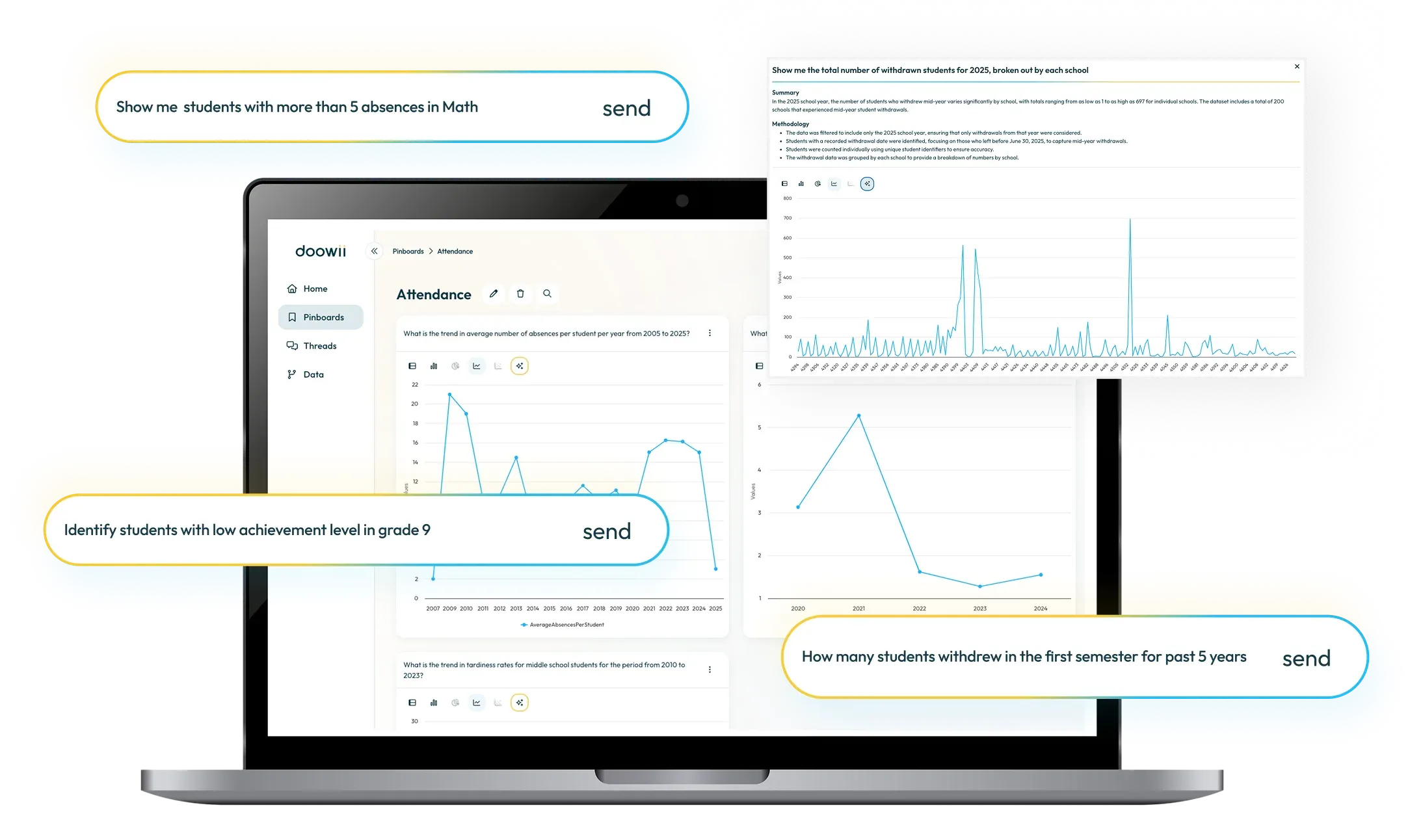
No. Staff can ask questions in plain English and review the resulting chart, report, or dashboard. District data leaders set definitions, permissions, governance, and review standards while Doowii runs the platform and repeatable analytical work.
Which K-12 data sources does Doowii connect to?
Doowii connects to the systems districts already use, including student information systems (SIS), learning management systems (LMS), ERP, CRM, and assessment platforms. It unifies them on one governed platform.
Is Doowii safe for student data?
Doowii maintains a SOC 2 Type II report. Its controls and privacy practices are designed to support districts' obligations under FERPA, COPPA, CCPA, GDPR, and other applicable laws.
How does Doowii help improve student outcomes?
Doowii helps authorized teams review relevant indicators, compare student groups, and bring context into intervention and resource decisions. The platform supports human review; it does not determine interventions or guarantee student outcomes.
How is Doowii different from a dashboard or a generic AI tool?
Doowii begins with an education-oriented data model and semantic context, then configures definitions, permissions, and analytic workflows around the district's systems and practices.
Bring district teams onto one unified platform
Request a walkthrough tailored to your district's systems, teams, priorities, and representative K-12 workflows.