What is education-specific AI analytics?
Education-specific AI analytics applies education context, governed definitions, and reviewable AI workflows to questions about institutional data.
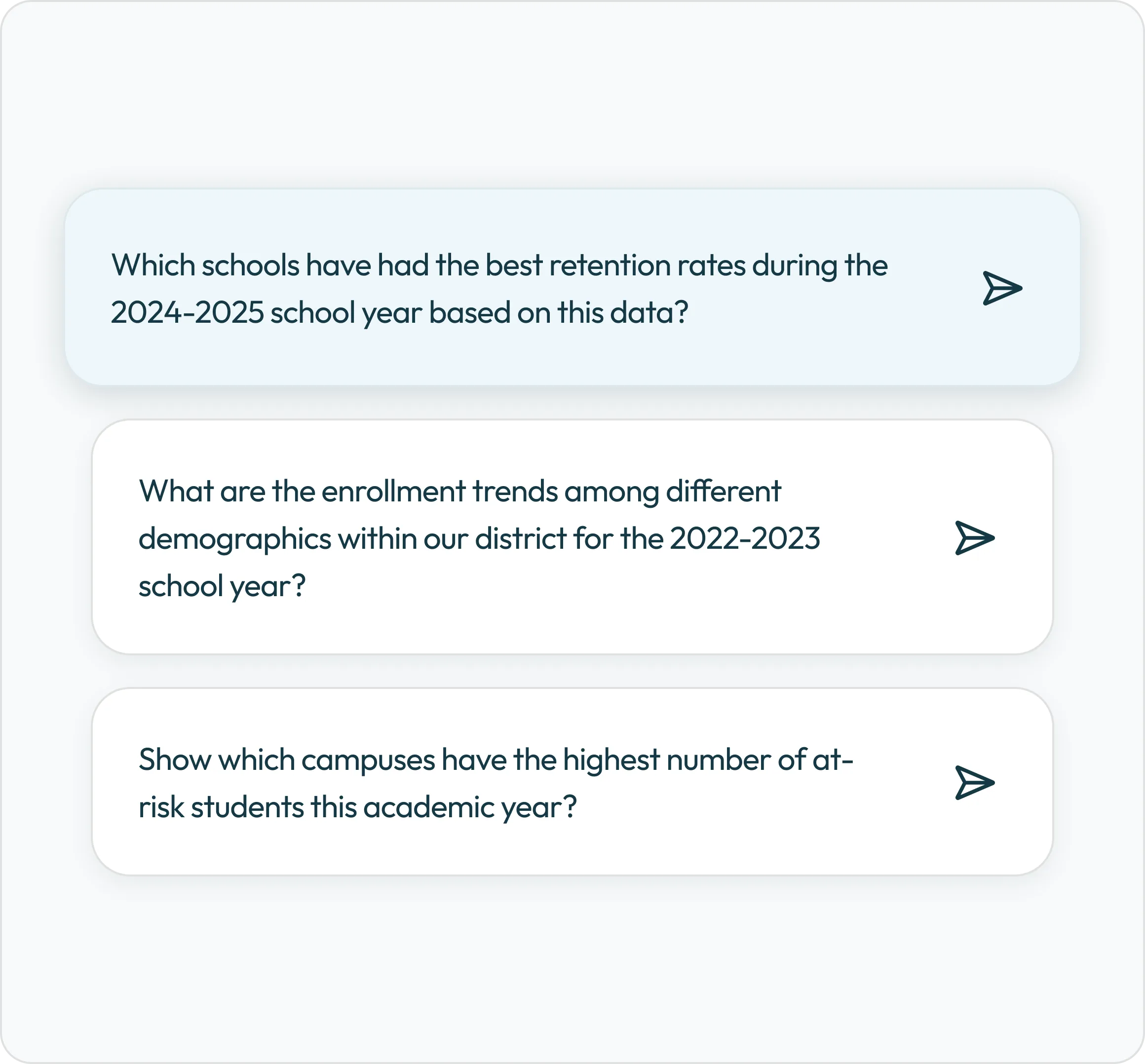
Education-specific AI analytics applies AI to governed institutional data, local definitions, and role-based access. Authorized teams can investigate questions, prepare recurring analysis, monitor defined indicators, and review the sources and methodology behind a result.
It differs in its starting point. General business-intelligence tools and AI assistants can support education, but institutions usually have to supply the education data model, definitions, permissions, and operating context.
What general-purpose tools leave to the institution
General-purpose platforms are deliberately flexible. Applying them across a Student Information System (SIS), Learning Management System (LMS), ERP, and CRM usually introduces three areas of work:
- Education context must be modeled. Enrollment, attendance, cohorts, terms, and interventions need documented local meaning.
- Self-service still needs governance. Institutions must decide who can ask which questions, which definitions apply, and how results are reviewed.
- Privacy obligations shape the design. Access and data-handling practices need to reflect the institution’s role, policies, contracts, and applicable law.
What makes analytics “education-specific”
Four capabilities matter:
- A connected education data model: the platform reconciles identities, time periods, organizational hierarchies, and relationships across systems such as the SIS, LMS, ERP, and CRM.
- Institution-owned meaning: terms such as enrollment, persistence, cohort, attendance, and intervention are configured around local policy, purpose, and ownership instead of assumed by the model.
- Governed access and review: permissions, source context, methodology, validation, and human responsibility remain part of the workflow.
- Managed operation: connections, models, definitions, and workflows need maintenance as source systems and institutional requirements change. A useful platform accounts for that work after launch.
For a closer look at how ownership, definitions, access, quality, and lineage reach analytics and AI workflows, explore higher education data governance.
The operating model also changes by audience and workflow. See how it applies to AI analytics in higher education and K-12 AI and data analytics, including concrete questions, required data context, review roles, and buyer evaluation criteria.
What you can do with it
With approved sources, definitions, and access configured, teams can investigate questions such as “Which institution-defined retention indicators changed this week, and which contributing factors warrant review?” or “How does this metric compare with a selected IPEDS peer group, and are the measures comparable?” The result should retain enough source and methodology context for an authorized person to validate it before acting.
That is one capability within Doowii, the unified data platform for education, managed end to end and configured to each institution. If you’d like to see the platform and talk through your workflows, request a demo.
See the unified platform in practice
Explore representative education workflows for governed questions, reports, and shared metrics.